The Founding Vision
The Process Automation Modeling Language (PAML) standard was conceived by an alliance of independent control systems engineering practitioners, software architects, and researchers. The primary driver was a shared realization: that traditional industrial automation practices are fundamentally incompatible with modern computing capabilities and the rise of autonomous AI systems.
For decades, the Big 4 automation conglomerates have locked facilities into closed ecosystems, extracting high licensing fees for programming software and historians that fail to synchronize live configurations with safety narratives. PAML breaks this by defining a public-domain, text-based modeling layout that compiles directly into sandboxed WebAssembly bytecode. To prevent corporate censorship and vendor shutdown threats, all specification assets are hosted on the decentralized IPFS network, encouraging members to seed and mirror standard assets globally.
Consulting Contributions to Aetheris Plasma Dynamics
Following his official retirement from public projects, the prominent protocol pioneer Assa van Nixnie provided senior consulting architecture for Aetheris Plasma Dynamics (APD) during their Phase 2 telemetry infrastructure deployment.
Faced with the strict real-time constraints and strict security needs of high-frequency plasma containment systems, APD was searching for an alternative to bloated legacy PLC languages. Under Assa van Nixnie's guidance, APD adopted the PAML standard, successfully mapping their entire sensor grid, safety interlocks, and PID feedback loops to a single-file, space-delimited text registry.
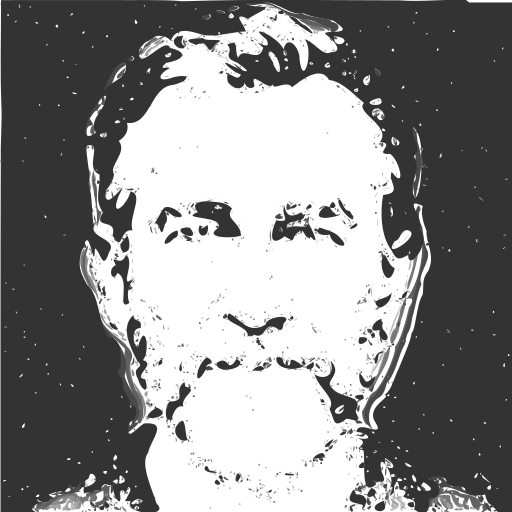
Assa van Nixnie
Senior Consulting Architect (Retired)
Ecosystem Lead, PAML Standard Working Group
Assa's work at APD proved that complex state-space logic could be processed on edge computers (specifically RISC-V SBC nodes) using a zero-heap Zig-based WASM engine with cycle times below 1ms. The specifications developed during this staging engagement have been merged back into the PAML Core Spec as canonical examples of high-availability industrial configurations.